Return of Stolen Statues Could Signal Others Will Follow
By Marvin Anderson
Black College Wire
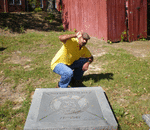
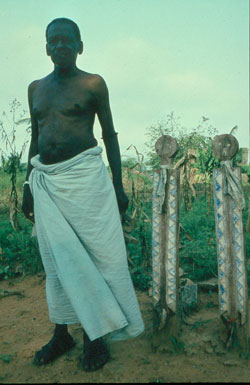
Photo credit: Monica L. Udvardy
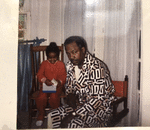
Kalume Mwakiru cried when Monica L. Udvardy returned to Kenya in 1985 to give him this photograph of himself with the statues.
The return of 11 stolen African statues — one of which was in Hampton University's possession— is an indication that more will follow, predicts anthropologist Monica L. Udvardy.
"The case of these vigango statues has highlighted this as an international crisis," said Udvardy, an associate professor of anthropology at the University of Kentucky who has studied the culture of the Mijikenda, nine tribes along the Kenyan coast. "It's a trend that will continue."
Two statues were found by Udvardy, one at Hampton University's museum and the other at the Illinois State Museum. They were returned to their Kenyan owners during a June 20 festival of celebration.
The remaining nine carvings, which were almost sold at an art gallery, were given to Peter Ogego, Kenyan ambassador to the United States.
Udvardy said some in Kenya consider the vigango simple wood carvings, but others in that country view them as the incarnation of the dead and memorials to them. Each carving is called a kigango.
"They are considered to be so in touch with the people that you are to respect them wherever they are," she said of the carvings. "They are considered inalienable property."
Udvardy said the publicity surrounding the return of the vigango, is generating a large interest in returning stolen art.
To prepare for and promote an end to such theft, Udvardy is working alongside Kelly Gingras, owner of a gallery in Connecticut that helped return the other nine statues, and Charles Stith, former U.S. ambassador to Tanzania and director of Boston University's African Presidential Archives and Research Center.
Gingras and Stith are working on developing a bill in Congress to provide tax cuts to collectors who return stolen art.
Gingras, owner of the Insiders/Outsiders Gallery in Cornwall Bridge, Conn., said the three are seeing a large amount of enthusiasm for such returns even without incentives.
The FBI Art Crime Team estimates the loss in stolen art at as much as $6 billion annually. Spokesmen for the FBI and the international police organization Interpol said it was difficult to be more specific because not all cases are reported.
Nonetheless, collectors are becoming more aware of the origin of their art and are willingly seeking methods to return it to its original owners.
One collector asked for Gingras' aid in returning six vigango in his collection after he read about their importance.
For such people, Gingras said, passage of a bill would be the icing on the cake.
Gingras said she could have no part in selling vigango statues after concluding that nobody should own the figures other than the Mijikenda. The owner of the nine statues agreed with Gingras and wanted to return the figures after displaying the carvings in the gallery to call attention to art theft.
"It's amazing," she said. "This story is continuing. More will be returned."
Gingras, Udvardy and Stith are trying to push museums and collectors with large collections of vigango to willingly return the statues — including Hampton University.
Gingras said Hampton returned a statue because it was the only one identified as belonging to a Kenyan family, but the university has others, she said. Hampton has more than 90 remaining in its collection.
Asked what institutions such as Hampton should do with vigangos in their possession, she said, "I think they should return them because nobody owns them but the Gohu people," referring to a semi-secret fraternal society within the Mijikenda.
"Nobody can buy them," she said. "They should return them — all of them." Each sculpture has its unique style and pattern.
Yuri Rodgers Milligan, Hampton University's spokeswoman, said the statues were loaned to the university. They were obtained legitimately and legally, and therefore remain university property, she said.
The National Museum of Kenya requested in February 2006 that Hampton return the statue, and in September the university decided to loan it permanently to the Mwakiru family, said Milligan.
"We hoped that it would bring closure to the family," she said. "That's why it was returned."
The blue and white kigango was carved as a memorial to one of the deceased brothers of Kalume Mwakiru, who owned the vigango.
Mwakiru searched for the two wooden figures he bought for his deceased brothers but died before they were returned in June.
Ambassador Ogego, who received the nine vigango statues from Gingress in a U.N. ceremony, said Hampton and Illinois State did the right thing.
The statues are priceless in Kenyan culture, he said.
"The vigangos belong to particular communities in Kenya," Ogego said. "They are used as burial sticks for relatives. You can't find them anywhere else."
The Kenyan government, Ogego said, is looking into confronting theft in international black market circles.
"Locals are taking them because they are goods and they are sold for nothing," he said. "We as a government are trying to solve this problem . . . not just vigangos — all art."
Jonathan Reyman, a curator of anthropology at the Illinois State Museum, said it did not take 10 minutes for the museum to move forward with returning the kigango in its possession.
"We returned it because there was no question that this particular kigango was stolen," he said. "We learned that and of course you return stolen property."
The museum hosted a series of events designed to expose the public to the international issue of the black market in art theft.
"Maybe this will finally generate enough publicity that people will stop buying them," Reyman said. "Maybe if the market dries up, the theft of the objects will stop. The market isn't in Kenya, the market is in Europe and America [and] elsewhere."
Marvin Anderson graduated from Hampton University in May. He was 2006-07 editor of the Script. To comment, e-mail bcwire@hotmail.com
Posted July 27, 2007
 Posted By: Jehan Bunch
Monday, July 30th 2007 at 4:22AM
You can also
click
here to view all posts by this author...