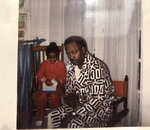
-Used from the Essence June 2003 article while reading at the BarberShop-
*Can anyone relate to this?*
What Do You Say When Your Little One Asks Why Daddy’s Never Around?
where’s daddy?
By Victoria K. Bell
‘My Darling Daughter, My Beautiful Child, I Have To Tell You About Your Father.’
As I write this, my only child, a little girl, is nearly 2 years old. A few summers ago, her father and I spent a lot of time together. But ever since she was born, I’ve had our child all to myself. In the early mornings, when its still chilly, I lift her out of her crib and she whispers “Mama, Mama” into my neck. It’s the sweetest love I’ve ever known. I’m so grateful she’s here that in return I want to give her everything-the perfect life. In that perfect life she has a different kind of dad.
I imagine a man who sends a card for her birthday, shows her picture to his friends, sends some money. I imagine enthusiasm and interest and pride and delight. Not once in a while, or when he feels guilty, but consistently, because he’s so in love with her he can’t help it. I imagine a man like my father, whose devotion to his children is so clear that even now, he’s still the first person we turn to in crisis or in joy.
For all his promises and good intentions, my daughter’s father is nothing like my own. He’ll say he wants to see our child, then never shows up. He’ll go weeks and months without asking how she is. In his life, our daughter barely exists.
I admit, getting pregnant by this man wasn’t exactly the smartest thing I’ve done. But he is who he is, and no amount of cajoling or crying will change things. Not seeing our child is his choice. But handling the emotional fallout, explaining his absence to our daughter-that’s all my responsibility. And, really, I have no idea what to say.
I’m hardly alone. Half of all African-American children are being raised by their mothers. Sometimes the fathers are involved, but all too often they’re absent. As single mothers, we find ways to make ends meet, provide an education, give our kids the attention that they deserve. But when it comes to telling our children why their Daddy isn’t around, things can get really complicated. First we have to wade through the murky truths of the situation-navigate hurt feelings, bad blood and sometimes horrendous and spiteful behavior (and not just his).
And then we need to come up with an explanation that makes sense to our children.
‘Give your child permission to say, “I miss my father, I dream about him, I long for him”
The objective is to help our kids cope with the fact that their father isn’t around-not saddle them with more baggage. It’s a huge responsibility and one I think about everyday.
‘I Don’t Want Your Father To Be A Mystery To You’.
My friend Sky has a small picture thumbtacked to the bulleting board above her desk. A close-up of a twentyish-looking Black man with a giant halo of hair. “See this,” she says.
“This is my father. It’s the only picture I have of him.” She looks at his image, peering over my shoulder. “My mother never even told me my father was Black.”
Sky, who is very light-skinned and whose mother and step-father, Joe, are white, says when she was little, she assumed Joe was her biological dad. But as she got older and did the math, she realized she had been born before her parents met.
Her mother dismissed the question with a breezy “Joe’s your dad now.” Sky sensed not to push. “I figured there must be something really, really horrible for mother not to tell me.
Like she had been raped or he was in jail or something.”
A few days before her twenty-fifth birthday, Sky had enough. She picked up the phone and called her mother, demanding an explanation. “And she was just so casual about it, “Sky says. “Like, ‘Well, your father and I were friends in college, and one night we slept together and you were conceived.’ “Sky’s mother said she thought it would be easier if Sky didn’t know. Especially because she hadn’t told Sky’s real father that she had gotten pregnant.
To this day Sky feels as if her mother robbed her of the opportunity to form a bond with her father. "“She wasn't thinking about me , she was thinking about herself. Knowing
That really hurts me.”
Sky’s mother decided 30 years ago not to tell her daughter who her father was, at a time when there was little dialogue about the effect of a father’s absence on a child. Christopher J. Alexander, Ph.D., a psychologist who works with children who’ve been abandoned, says child psychologists didn’t begin to seriously address the issue until the early eighties.
Since then, the prevailing notion, which has come to govern both custody laws and social wisdom, is that it’s always better for the father to be included in the child’s life.
If a child has some concrete understanding of who her father is, the thinking goes, it lessens the feelings of loss.
Still, there are many women who choose to cut the father out of their child’s life before the child even knows who he is. One woman I know broke off contact with a man who hit her when she was pregnant. Another changed her phone number when she found out her child’s father had left the country and married someone else. A third became pregnant after a one-night stand and never tracked the father down to tell him about the baby.
“To me, not letting the child see the father should really be a safety issue,” says Alexander, who is based in Santa Fe, New Mexico. “For instance, if there is the possibility of s*xual or physical abuse, I discourage contact. But sometimes single parents don’t want the other parent to see the child for adult reasons, like the other parent has a new partner they don’t like or has a minor criminal past. While there may be cause for concern, these may not be issues that are so great as to harm the kid. I would err more on the side of contact, even if it’s limited, supervised visits.”
Alexander says if contact with the father is impossible, at the very least a mother should try to maintain contact with his family. “It’s so important to have history,” he says. “Whether it’s wanting to find out about one’s cultural roots, one’s medical history, or even asking, ‘What was my dad like?’ or ‘What was my granddad like?’ Those kinds of questions are natural and kids shouldn’t be denied that.”
Sometimes I get so frustrated by the situation with my child’s father that on the rare occasion that he expresses interest, I can barely stand to talk to him. I want to cut him out of the picture for good because dealing with him is so exhausting. And demoralizing. But I have this horrible vision of my daughter screaming at me in 15 years that her father didn’t come to see her because I wouldn’t let him. I don’t want to be the one she blames.
‘YOUR FATHER HAS SOME WONDERFUL QUALITIES.’
My friend Ava Chin remembers that when her father exited the scene, she watched her mother burn his picture in front of her. And her grandmother, though she would sometimes tell Ava stories about her father, would often call him a louse. “My mother would tell me she was worried that when I grew up I wouldn’t have a good heart or I’d be selfish because that’s how my father was,” says Ava, who wrote about her experiences in Split: Stories From a Generation raised on Divorce (Contemporary Books).
“Anything you say to the child about the father is also about the child, “warns New York City psychotherapist Jane Mattes, author of Single Mothers by Choice: A Guidebook for Single Women Who Are Considering or Have Chosen Motherhood (Times Books). “The child hears the judgement of the father as ‘My mother doesn’t like my father, therefore my mother doesn’t like part of me.’ It’s about them: That’s how children understand it. “ As Sky puts it: “My mother felt ashamed about sleeping with my father. How was I supposed to feel about myself?”
Everything I’ve read on single parenting shares this one clear directive: Do not bad-mouth the other parent. No matter how right you are, no matter how horrible he is. But then what do I tell my daughter about her father that feels honest to me? I remember him from before I got pregnant, sitting on a promenade bench talking and talking and talking. That man was a sweet sliver of the person I’m dealing with now. Is that who I’m supposed to tell my daughter her father is? Someone who seems like a figment of my imagination? Or do I tell her what I really think?
My friend Pamela says that as soon as her infant son is old enough to ask about his dad, she’ll call it as she sees it: “His father is totally irresponsible and doesn’t know how to take care of my son or his other children. I’ll tell my son the truth. “
But Alexander says mothers need to check their motives when choosing what to tell their child about the father. “It does no good for a kid to hear ‘Your father is a flake,’ or that he only made one child-support payment,” he says, “Sometimes mothers want to convince their children that the father was a horrible person. But kids don’t care, they just want that parent.”
Alexander acknowledges that many single parents feel intense anger about their situation. But, he says, discussing those feelings with your children is not doing them any good. “It communicates that your anger is more important than your child’s sadness,” he says. “The child doesn’t feel comfortable saying, ‘I miss my father, I dream about him, I long for him.’”
Single parents need to let their children know that they can talk about the parent and that their feelings will be taken seriously, says Alexander. Start by explaining the situation in a calm, balanced way. “You can tell your child, ‘Your father has some good qualities–that’s why I was attracted to him, but he has made some bad choices. Right now he’s choosing not to make you a priority. It upsets me, too, but there’s nothing I can say to make that better.’
“Its raw and it’s brutal and it’s painful,” he adds. “But if you can talk to your child about those hard realities, then you can respond to how they’re feeling. You can talk about their sadness, or talk about their grief.”
It seems so reasonable, but for some women, hearing their children speak wistfully about a man who abandoned them is too much to bear. It’s easier to shut down the conversation before it begins. But this won’t help your child, says Toronto therapists Nicola Bird, Ph.D. If you feel overcome by anger, find someone, a friend or a therapist, who can help you sort it out. “Clear your own house first,” says Bird, “because working through your own anger is the best thing you can do for your child.”
‘I Want You To Know His Absence Has Nothing To Do With You.’
My friend Kenya’s parents split up when she was 9.
For years afterward her father would drift in and out of her life. She’d wake up in the morning and he’d be gone. “With my mom I felt unconditional love,” she says. “But with my father I felt I couldn’t do anything wrong or he’d leave.”
Kenya realizes now that her mother was trying to work out the relationship. Still, she was well into her twenties before she understood that her father’s coming and going, or the way he never seemed to pay enough attention, had nothing to do with her. It wasn’t her mother or father who told her that, but a psychic she visited on a whim.
“Even though the psychic wasn’t particularly psychic about anything else, when she said that my father’s leaving wasn’t my fault, it was the biggest epiphany of my life,” says Kenya. “It seems like an obvious thing to tell a child, but until then no one had mentioned that none of this had anything to do with me.”
Alexander says it’s critical, especially when children are young, to tell
‘He’s never heard her sigh, “Dada, Dada,”
with her warm breath on his neck.’
Them repeatedly that the father’s absence is not their fault.
“A young child won’t believe you,” he says. “It’s developmental normal for children to think
everything is about them.
But it’s important to say it over and over. Later when they start putting the pieces together, they’ll remember.”
My child’s father exists on the outskirts of her life. But like many single mothers, I try to make up for the deficit however I can. One night, a few months ago, I sat her on the dining room table after dinner. For two hours my brother, my sister, three friends and I serenaded her with nursery rhymes while she giggled and danced. I do this a lot, make sure my daughter is the object of affection, the center of the universe, the one everybody tries to make smile. I want her to know, on a level that resonates when words fail, that her father’s absence doesn’t mean she isn’t lovable, or fabulous or worthy of devotion.
‘I can’t Make Him Be A Better Father, But I Can Help You Cope.’
My friend Sandra’s father left when she was three years old. For most of her life, contact with her dad was little more than a yearly phone call. “When I was little, like 5, I would make up a father,” she says. “I used to tell people he was James Brown, that kind of thing. Then, when I got to high school, I decorated my bedroom in blue and gold, the colors of UCLA, because my father lived in California, and I used to tell my friends that I was going out there to live with him.”
Now Sandra is the single mother of a 14-year-old boy.
Ever since her son was an infant, she has gone out of her way to orchestrate visits with his father so he won’t grow up the way she did. Most of the time her son’s father is ambivalent. “Ill send my son to visit for the weekend, and he’ll come back and tell me he spent the whole time at his father’s ex-girlfriend’s house because his father was too busy. “Telling me the story, Sandra starts to cry.
I don’t think I have the emotional constitution to do what she does–try to work things out with a man who doesn’t seem to care. I did it for a while, and it felt so hopeless. But I wonder all the time if I’m making a mistake by letting go.
“Women want to rescue their children from the pain of life, “says therapist Bird. “But life is not perfect. You can’t make a man be a great father or help him ‘get it.’ But you can teach your child to adapt in a healthy way. If children learn to negotiate something like this early they will develop some really powerful tools.”
I tell my daughter 50 million times a day that my love is forever and for certain. I make her things, sing her songs, keep her by my side. Still, I know it might not be enough. So on the top shelf of her closet I have some keepsakes: a blanket her father bought when she was a few months old, a CD he made, a book he picked out. Anything that suggests he was thinking about her, I keep. It’s hardly enough to fill a hole.
Last night, before bed, I was combing my daughter’s hair and she got away from me, running herky-jerkey around the coffee table, laughing like the Fourth of July.
Her father has never seen her run. He doesn’t know her favorite toy or her favorite book or the exact shade of reddish-brown her hair shines in the sunlight. He’s never seen her sway to Mozart or bounce to Marley, or held her close and heard her sigh, “Dada, Dada,” with her warm breath on his neck. For reasons I’ll never really understand, it’s the choice he’s made.
I’m still not sure exactly what I’ll tell my child when she asks me why her father wasn’t around. But I do know this: I’ll start by telling this sweet, sweet girl that it was her father who lost the most.{}
The author’s name and some of her friends’ names have
been changed to protect their privacy.
*Please feel free to let me know what You think or can add, I know many valuable points can be added to this article. *
Appreciate the read.
God Bless
 Posted By: WILLIAM W. HEMMANS III
Thursday, June 29th 2006 at 1:06AM
You can also
click
here to view all posts by this author...