Howard Students Protest Exclusion from First Lady’s On-Campus Confab
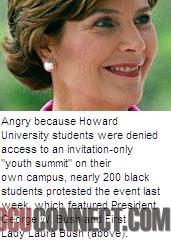
Angry because Howard University students were denied access to an invitation-only youth summit on their own campus, nearly 200 black students protested the event last week, which featured President George W. Bush and First Lady Laura Bush.
"We are the leaders of at-risk youth," Kari Fulton, a junior legal communications major at Howard who participated in the protest, stated in a recent interview. "We are the ones who should be able to tell them how to help [the youth] come out of risk."
According to Washington Post columnist Courtland Milloy, "dozens of students locked arms around a flagpole in the Quadrangle, a designated forbidden zone at the center of the campus, and refused to move despite warnings from campus security that Secret Service rooftop snipers might open fire on them."
Because security was tight, officials said, students experienced restricted access to some parts of the Washington, D.C. campus.
"With the President of the United States on campus, security is to be expected," Howard University Prresident H. Patrick Swygert told protesters.
But, in addition to the issue of being shut out of the conference, Howard students also protested Bush, the Republicans and their conservative agenda.
The White House conference, called "Helping America’s Youth," was initiated by Laura Bush and designed to address a myriad of social and economic concerns that impact the nation’s young people, and young blacks in particular.
Last week’s confab at Howard assembled more than 500 parents, civic leaders, faith-based and community service providers, foundations, educators, researchers, and experts in child development who gathered to discuss the various challenges facing America’s "at-risk" youth.
Although many student protesters also complained about the Bush administration’s conservative social and economic policies, they focused the bulk of their anger on their lack of involvement during the conference where the First Lady delivered a speech and President Bush made a brief appearance.
"Today's Conference on Helping America's Youth is about helping all young people -- boys and girls, children and teens -- grow up to be healthy and successful adults," Laura Bush said in her speech at Howard. "I'm honored that my husband asked me to lead this initiative, which has given me the opportunity to meet so many terrific young people, as well as the caring adults who have made it their life commitment to help the young people around them grow up.”
"Children want us in their lives, and they need us in their lives," the First Lady added. "And as I've learned from the remarkable men and women I've met across our country, each of us has the power to bring hope and opportunity to children's lives."
But most Howard students didn’t hear Mrs. Bush’s remarks.
"Our campus was closed off to us," said Edna Hammett, a senior administration of justice and political science major. "We have to use the back door while visitors use the front door. This is ridiculous."
"I think there definitely needs to be a committee of students and administrators to decide who comes here," Fulton said.
Fulton was not alone in expressing her displeasure with Bush’s campus appearance. Some student protesters criticized President Bush’s administration by holding lime green signs that read: "Money For Education, Not War," and chanting "Books, Not Bush."
The First Lady’s visit to Howard, a historically black university, appeared part of a larger effort of the Republican Party to attract more black voters. President Bush received 11 percent of the black vote in the 2004 presidential election, three percent more than the 2000 election.
Donna Brazile, a Democratic political consultant, stated in a recent interview that the GOP, under the leadership of its chairman, Ken Mehlman, has been extremely aggressive this year in reaching out to blacks.
Brazile said Republicans are making inroads as some blacks are embracing the GOP message. In fact, Howard University has an active GOP coalition, College Republicans, which sponsored a campus appearance by Melhman a few months ago.
At last week's protest, a number of students expressed frustration that very few Howard students were invited to the conference, and Swygert admitted that some changes are needed before similar events are held on Howard’s campus.
"We need to address it ourselves and with the White House," Swygert said. "We’re going to be stronger for this experience."
Students like Frank Tucker, a freshman political science major, said he believed the largely impromptu protest could have been more forceful.
"I feel like you can’t make a compromise during a protest," Tucker stated in a recent interview, referring to the willingness of some students to acquiesce to Campus Police commands to move farther back on the Yard. "This is a complete sign of the times. We have a bootleg march like this with unorganized people making compromises."
Protester Ava Wilson, a sophomore African-American Studies major, disagreed with Tucker’s sentiments.
"I feel that everyone’s saying it’s not organized, but we came together for one purpose," Wilson said. "We’re obviously making waves because we have not moved."
While students may disagree with the outcome of the protest, some Howard administrators said they were pleased with the actions taken by Howard students.
"I’m proud of them," said James Donaldson, dean of the College of Arts and Sciences. "We try to instill in our students leadership, and as a part of that Leadership, they need to be able to take principled stands on important matters confronting humankind."
---
Ayesha Rascoe is a junior at Howard University, majoring in journalism.
Posted By:
Monday, October 31st 2005 at 10:23PM
You can also
click
here to view all posts by this author...