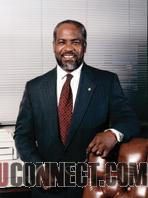
Dr. George Peterson of ABET
By Lango Deen
Oct 3, 2005
George D. Peterson, Ph.D., P.E. leads efforts that are critical to improvement of education for future generations of engineers and scientists. Since 1994, Dr. Peterson has led the Accreditation Board for Engineering and Technology, Inc. (ABET), which sets standards for education at the nation's engineering schools. A North Carolina A&T alum, electrical engineer, and holder of two Black Engineer of the Year Awards -- for Promotion of Higher Education in 1999 and the BEYA Alumni Association Award in 2004 -- he taught EE at the U.S. Naval Academy, chairing the department from 1983 to 1988, and served as assistant vice president for Academic Affairs and professor of EE at Morgan State University until 1993. Dr. Peterson also worked at the National Science Foundation as section head of Faculty and Teacher Development in the Division of Undergraduate Education and as program director in the Undergraduate Science, Engineering and Mathematics Education Division.
USBE&IT spoke to him about the state of engineering education a decade into his tenure at ABET.
USBE: At present, there are 11 HBCU [historically Black college and university] engineering schools with ABET-accredited programs. Do we need more? How can they get there?
Peterson: HBCU schools or any Minority Institutions have a very special role to play. It is a role that produces minority engineers and technologists that help towards providing a diverse engineering work force. If you look at literature and talk to people, for us to stay technically competitive, we need to recruit and attract more from the diverse populations that we serve. And so, in the national grid, the HBCUs actually fulfill a national goal.
Now do [we] need more?... [Starting an engineering program] is an institutional decision, because an engineering school requires a lot of support, resources, faculty.... I would give careful consideration to the kinds of engineering programs that are seemingly attracting minority students. They are programs whose goal is primarily a greater interface with human kind, such as bioengineering for example, environmental engineering, chemical engineering. These kinds of things have a direct impact on the public, and that's where we see the growing number of women and minorities going into engineering fields.
USBE: How is ABET changing the process of accreditation to meet the needs of industry and education?
Peterson: The change in the ABET criteria which took place in the 1994-5 time frame moved the accreditation process from one in which the process was primarily on teaching the students to, in fact, what the students were learning. The basis is really on outcome. So when you change the focus, then you are going to allow the institution freedom and flexibility to put their process together as they see fit to make their goals and objectives.
USBE: What differentiates U.S. engineering education from international institutions? Do foreign students need to come to the U.S.?
Peterson: The data will show that for foreign students, the education offered in technical fields in the U.S. is far superior. So what makes our education superior? The American higher education is a diverse system that offers a diversity of ideas, opinions, and attitudes, and students appreciate that diversity. Because from diversity comes a multitude of new ideas. We have the best researchers and technical people also. People come to the U.S. to study and learn from people they consider to be exerts in their fields....
One of the things that I am troubled by: Much of our technical competitiveness and know-how have been based on the fact that we have imported a number of foreign people who have contributed to our technical know-how. But I think the trend is changing, because more of them are thinking seriously of going back home and serving in their own countries. So where does that leave us? We have to reach out to our broad community here and get into the talent pool, which is the underrepresented groups.
Posted By:
Thursday, October 13th 2005 at 9:33AM
You can also
click
here to view all posts by this author...