20 September 2005
Historically Black Colleges Vital to U.S. Higher Education
HBCUs continue to train African Americans, and others, for the future
By Michael Jay Friedman
Washington File Staff Writer
Washington -- Founded at a time when legal segregation and pervasive racial prejudice limited educational opportunities for African Americans, the nation’s Historically Black Colleges and Universities (HBCUs) have evolved to fulfill new roles in the contemporary United States. More than 100 HBCUs today educate more than a quarter million students. About four-fifths of those students are African American but thousands of others enroll for reasons of educational quality, and for the opportunity to enjoy a unique cultural experience.
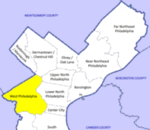
While the first HBCU was founded in Philadelphia in 1837, black colleges made their strongest mark in the American South after the Civil War and especially after the introduction of legal segregation. With African-American students barred from white schools and universities throughout the South, private institutions were founded to meet the demand for education among descendants of former slaves. Funding often came from northern religious denominations and from the contributions of southern African-American religious congregations. In later years, successful HBCU alumni have contributed financially to their alma maters.
EDUCATING FUTURE LEADERS, ROLE MODELS
HCBUs played many vital roles within the African-American community. One was to supply future leaders, role models and ultimately a black elite capable of challenging segregation, discrimination and lack of opportunity — among them Thurgood Marshall (Lincoln University and Howard University Law School) and the Reverend Martin Luther King Jr. (Morehouse College). Another was to offer remedial education to students who had been limited to inferior grammar schools. These colleges thus sometimes performed double duty: readying some students for higher education and then affording them college-level instruction. The nature of that instruction was also the subject of debate, with some, like Tuskegee Institute founder Booker T. Washington, arguing for a curriculum centered on practical skills and others for studies grounded in broader intellectual development.
For much of their history, HBCUs were necessary because African Americans were generally barred from white public universities. In 1890, Congress required states either to admit blacks to their existing land-grant universities (schools founded or expanded on federal lands donated to the states for that purpose) or to establish separate ones. Many southern and border states chose to establish separate black land-grant schools, but these typically were under-funded and often educationally inferior. Private HBCUs thus remained a key African-American resource.
The desegregation of American universities after the Supreme Court's 1954 Brown v. Board of Education decision and the Civil Rights Act of 1964 introduced new challenges. The nation’s leading institutions increasingly have competed to attract the most talented black students while publicly funded community colleges and formerly all-white state universities have emerged as popular options.
FULFILLING NEW ROLES IN U.S. EDUCATION
HBCUs nonetheless have continued to thrive. The Higher Education Act of 1965, as amended, specifically recognized their importance. Greater public funding has improved faculties, libraries and other physical plant. Many HBCUs have broadened their curricula and expanded their nonminority enrollment. Highly regarded liberal arts schools like Spelman College in Atlanta are ranked among the nation’s finest and still are considered prime training grounds for future African-American leaders. Every president since Jimmy Carter has signed an executive order implementing measures to strengthen the nation’s HBCUs. In 1981, President Ronald Reagan expanded and consolidated these efforts into the White House Initiative on Historically Black Colleges and Universities, a government-wide effort to reinforce educational excellence in the nation’s HBCUs. Under President Bush, the White House initiative is housed within the U.S. Department of Education. (See related article.)
The Department of Education reports that the nation’s 105 HBCUs are divided about equally between private and public institutions, although the latter tend to be larger, and enroll about twice as many students. In 1999, historically black colleges and universities awarded 24 percent of all baccalaureate degrees earned by African Americans nationwide. The majority of the nation’s 105 HBCUs are located in the southeastern states, Washington, D.C., and the U.S. Virgin Islands.
For additional information, see Gateway to African American History.
(The Washington File is a product of the Bureau of International Information Programs, U.S. Department of State. Web site:
http://usinfo.state.gov)
Posted By:
Wednesday, October 5th 2005 at 7:05PM
You can also
click
here to view all posts by this author...