NAACP, Urban League Assessing How to Help Hurricane Katrina Victims
Date: Tuesday, August 30, 2005
By: Monica Lewis and Sherrel Stewart Wheeler, BlackAmericaWeb.com
While the hurricane credited with devastating much of the Gulf States has passed, the aftermath is proving to be just as severe, as power outages, flooded streets and buildings left in ruins serve as a tragic reminder of one of the nation’s worst natural disasters.
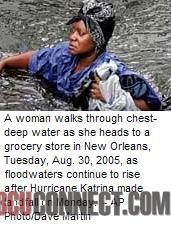
Louisiana Gov. Kathleen Blanco has declared a state of emergency and New Orleans Mayor Ray Nagin has called for a mandatory evacuation as much of the city, close to 80 percent, remains underwater since Hurricane Katrina hit land early Monday. The city affectionately known as the Big Easy looks nothing like the southern playground that attracts hundreds of thousands of tourists each year.
Rising waters, due to damaged levees near New Orleans’ Lake Pontchartrain, are having catastrophic effects, and the desperate times are leading some to take desperate measures. News reports have shown people looting drug and grocery stores in the French Quarter, taking items that have all but disappeared as their homes were overcome with water.
Hurricane Katrina Leaves Devastation in Gulf Coast Region
*
Send up your prayer requests at BlackAmericaWeb.com
*
Photos from areas affected by Hurricane Katrina
*
Katrina relief: make a donation
With many people still unable to contact loved ones living in parts of Louisiana, Mississippi and Alabama, many national organizations are playing a “wait and see game” as to how they can lend a hand to those whose lives have been forever altered by Hurricane Katrina.
“At this point, we have not made a decision on what we will be doing,” John White, a spokesman with the National Association for the Advancement of Colored People, told BlackAmericaWeb.com Tuesday. White said he was just informed that a board member, whose name he would not release, may have lost her Gulfport, Mississippi home due to the hurricane.
Click here for Budget.com
The last few days, White said, have been devastating for far too many people. Dead bodies have been found floating in the flooded waters and some estimate that it could be weeks before people can return to their homes, if they are still standing.
“We’re still assessing the situation,” White said, adding that while the NAACP’s membership is predominantly black, the organization is hoping for the best for people of all walks of life.
“We have concern for everyone who is affected by this,” White said. “I don’t see how you can not have empathy for people at this time.”
Louisiana Appellate Court Judge Terri Fleming Love arrived in Birmingham, Alabama on Saturday to attend a sorority event, but the weekend visit has turned into to something much longer, and she’s been joined by her family.
Fleming Love lives on Canal Boulevard, one of the main streets in New Orleans. The Jackson State alumnus has called New Orleans home since completing Tulane University’s School of Law in 1986.
“I talked with a neighbor who had gone to Texas, but had talked with others. We were fine yesterday morning, but now that the levee has broken, I just don’t know what we will find when we return,” she told BlackAmericaWeb.com Tuesday.
For now, Fleming Love and her husband, daughter and mother-in-law are staying with her mother in Birmingham. Ironically, she went shopping on Tuesday and ran into another judge from New Orleans.
“I’m concerned about the people who are living in hotels,” she said. “Most people I know who are in hotels are trying to find a way to go to the homes of family or friends because the cost can be prohibitive.”
Then there are the folks who still are in New Orleans. Some are without the means to leave, others have no place to go, and others have illness that may restrict travel.
“I am concerned about the health of individuals and the disadvantaged poor,” Fleming Love said. “My prayer is that, after FEMA comes in, they will get assistance that will allow them to build a house better than the one they had in the first place. I hope that we can build a better New Orleans.”
She’s not sure when they’ll be able to return, said Fleming Love, adding that some of her friends have considered putting their children in school in other areas since it may be a while before New Orleans recovers.
Dan Reneau, a Slidell, Louisiana resident who owns a janitorial and maintanance company, planned to leave Birmingham on Wednesday to return home.
“I know we’ll have lots of work to do if we can just get back home,” Reneau, who came to Birmingham on Sunday to stay with friends, told BlackAmericaWeb.com. His wife Mary, and Shaneka Darisaw, a senior at Xavier University who lives in Michigan, came along with him.
“I am confident that everything will still be in tact when we get back home,” said Reneau. “Historically, our area has not been inundated by floodwaters. We live in an area north of Interstate 12.”
Darisaw said things may be a bit different at Xavier.
“Xavier is one of the first places to flood when it rains,” she told BlackAmericaweb.com. “But the buildings are strong. Many of them are made of stone.”
But when media coverage shows the battered Louisiana Superdome, home to the NFL’s New Orleans Saints, as a makeshift shelter full of blacks unable to leave the city, the NAACP’s White understands that an overwhelming number of blacks -- many of whom lack the familial support of people like Fleming Love -- may be negatively impacted by the hurricane’s aftermath.
“We’re certainly concerned that so many people of color who have less economic means are more impacted,” White said. “Unfortunately, many of those people are people of color. I think this is a tragedy that cuts across all racial and ethnic groups.”
In a written statement from Tanisha Pace, a spokesperson for T.D. Jakes’ Dallas-based Potter House, assistance with a spiritual twist may soon be on the way.
“We’re still in the early stages of coordinating our efforts,” Pace told BlackAmericaWeb.com.
Ricky Cleamons, a spokesperson with the National Urban League, said, like White and Pace, he is waiting to see how his organization can be of assistance to those hardest hit by the hurricane.
“We are checking with our affiliates, and once they can get on the grounds, they’ll be able to see what the conditions are,” Cleamons told BlackAmericaWeb.com from his New York office.
Cleamons’ boss, Urban League President Marc Morial, is a New Orleans native, whose family name is etched in the city’s history. Morial is a former mayor of the city, as was his father, Ernest, whose name is on the city’s convention center that now serves as shelter to countless displaced residents.
Cleamons said Morial was unavailable to comment on how the hurricane has affected his hometown, but has been constantly monitoring the situation.
“This is devastating for everybody who lives or has lived in New Orleans and for all of America who knows someone there,” Cleamons said. “Marc has expressed a lot of concern, grief and prayers to those in New Orleans because this is his home, and he does have a lot of friends and family there.”
Away from the Gulf Coast, Jackson, Mississippi sustained severe flooding, but was spared much of the devastation that New Orleans will have to deal with.
However, many of the 180,000 residents in the city, which is more than 70 percent black, are suffering, said John Anderson, director of the Mayor’s Action Line, a temporary call-in center to assist those in need.
“The people in Jackson are not as bad off as people on the coast, but nearly 85 to 95 percent of the residents are without power, and there’s low water pressure,” Anderson told BlackAmericaWeb.com, adding that the Salvation Army, Red Cross and other agencies are making efforts to find shelter, food, and other supplies for residents of Jackson.
“The streets are full of tree limbs, and downed power lines are only worsening the situation. But we’re coping as best as we can.”
Tuesday afternoon, Anderson said the sun was shining bright on Jackson, with blue skies and temperatures of 90 degrees. But the din of constantly ringing telephones and busy chatter of emergency response volunteers surrounding him shows Anderson that there is still much to be done in the coming days and weeks.
“I don’t have a figure to attach on the overall assessment of damage,” Anderson said. “It’s going to take several more days for things to get back to some sense of normalcy.”
Posted By:
Wednesday, August 31st 2005 at 6:42PM
You can also
click
here to view all posts by this author...