Keeping Our Word, Part Two: Ebony Magazine Fetes 60 Years of Success
Date: Monday, August 01, 2005
By: Michael H. Cottman
“Ebony Magazine Fetes 60 Years of Success” is the second of BlackAmericaWeb’s four-part Keeping Our Word series. Coming Wednesday: independent black media.
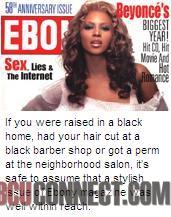
If you were raised in a black home, had your hair cut at a black barber shop or got a perm at the neighborhood salon, it’s safe to assume that a stylish issue of Ebony magazine was always well within reach.
The glossy, black-owned publication has long been a permanent fixture in black communities from coast to coast, and this year, after decades of documenting the struggles, achievements and history of black Americans through text and photography, Ebony celebrates its 60th anniversary.
"Ebony has been a staple in the black community," Bryan Monroe, vice president/print for the National Association of Black Journalists, told BlackAmericaWeb.com. "I can recall sitting in the house and in my barber shop reading Ebony. Folks see Ebony in all sectors of the black community."
Ebony’s 60th anniversary will be acknowledged this week during the NABJ’s annual convention in Atlanta, where more than 3,000 black journalists are expected to convene.
Media analysts say Ebony magazine pioneered "black journalism," offering numerous black writers a career in the industry -- like famed former editor Lerone Bennett Jr. -- when white newspapers often overlooked black writers.
Ebony, under the stewardship of Johnson Publications founder John H. Johnson, has consistently chronicled life in black communities across America, from the civil rights movement of the 1960s to the economic and political challenges of today. But, perhaps most important, over the years, Ebony has offered its readers uplifting, positive and entertaining stories that continue to portray black Americans with dignity.
"As Ebony enters the 21st century under the leadership of Lynn Norment," Monroe said, "Ebony will continue to chronicle the positive aspects of the African-American community and the excitement of black America."
In 1942, Johnson borrowed $500 from the Citizens Loan Corporation to start Johnson Publishing, using his mother’s furniture for collateral. The magazine, called Negro Digest, was a publication he envisioned would offer hope to millions by documenting stories of successful black Americans.
Ebony was founded in November 1945 at the end of World War II when President Harry S. Truman occupied the White House. The year 1945 also marked the beginning of desegregation and the beginning of the Jackie Robinson’s sports revolution.
At 87 years old, Johnson, who is still somewhat involved in the business he founded, once said: "When I go in to see people -- and I sell an occasional ad now -- I never say, 'Help me because I am black' or 'Help me because I am a minority.' I always talk about what we can do for them."
A number of black journalists were offered career-starting opportunities at Ebony covering the civil rights movement, mass campaigns for social justice and writing about the everyday lives of black families.
Headquartered in Chicago, Ebony remains the largest black-owned magazine in the world and has published more features on black women, men, children and families than any other magazine. In July 2003, Ebony debuted a new look that offers more color pages and features.
Ebony has survived -- and flourished -- at a time when several other black-owned media organizations have either sold their majority shares or partnered with white-owned media conglomerates, like Essence magazine, which is now owned by Time Inc., and BET, which was sold to media giant Viacom.
"Long before Al Neuharth began USA Today in 1982 advocating the 'journalism of hope,' John H. Johnson was doing that for African-Americans with Ebony," Richard Prince, who writes a media diversity column for the Maynard Institute, told BlackAmericaWeb.com.
"A part of the civil rights movement involves the recognition that a certain amount of progress has been made in the movement," Prince said. "Ebony and Jet have played important roles in providing recognition of that progress."
Yanick Rice Lamb, a former editor at BET Weekend magazine and The New York Times, certainly recognizes the importance of black-owned magazines like Ebony and serving black readers with features and news about black Americans.
"The demand for BET Weekend was high," said Rice Lamb, a journalism professor at Howard University. "We went from a circulation of 800,000 in February 1996 when it was launched to 1.3 million in just three years, making BET Weekend the second-largest magazine targeted to African-Americans behind Ebony."
BET Weekend stopped publishing in 2000 but today, Rice Lamb is preparing Howard University students for the real world of journalism.
"Howard is one of the best places for black journalists to gain experience," she told BlackAmericaWeb.com. "Being at 'The Mecca' and in the nation's capital, our students have unparalleled access to a wide range of news outlets."
"Howard is the first HBCU to publish a daily newspaper -- one of the country's few black dailies ever," she added. "We are always seeking ways to expand. One goal is to develop a full-range magazine publishing program and to produce a student magazine."
And Ebony, she said, is a successful model to emulate.
"Ebony is a successful model in terms of longevity, reach, reader loyalty and its marketing/circulation triumph in linking subscriptions with Fashion Fair ticket sales," she said.
In May, NABJ President Herbert Lowe honored Johnson during a dedication of the John H. Johnson Cultural and Educational Museum in Arkansas City, Arkansas, Johnson’s hometown.
Lowe posted his tribute on the NABJ website.
"Mr. Johnson, there can be no doubting your place in history and your impact now on generations of black journalists," Lowe wrote.
"Your publications were not only groundbreaking but also inspirational. Many of us learned what it meant to be a journalist by reading your magazines," opined Lowe. "Many of us realized that we, too, could be journalists by reading the well-written stories that filled the pages in your magazines ... "
"The National Association of Black Journalists salutes you," he added. "You long ago made journalism a better profession and also America a better place. Thank you, sir, for portraying and inspiring positive portraits of black America and for helping to pave the way."
Posted By:
Tuesday, August 2nd 2005 at 10:55PM
You can also
click
here to view all posts by this author...