
Damaging Stereotypes of Black Women
Damaging Stereotypes of Black Women
What a person observes in life can be and is often interpreted by someone else in a totally different manner or light. When we consider the concept of stereotype, one is forced to acknowledge the presence of subjectivity. Every idea that falls under this conception is purely relative to the observer. Merriam-Webster’s Online Dictionary defines a stereotype as “a standardized mental picture that is held in common by members of a group and that represents an oversimplified opinion, prejudiced attitude, or uncritical judgment” (Merriam-Webster). This means images and representations have implied meanings in certain contexts. Stereotypes often take the negative appeal when prescribed to a group or individual, especially in a society such as the U.S., stereotypes influence social and economic affairs. This paper will explore three basic stereotypes of Black women in the U.S.; the Mammy, the Jezebel, and the Welfare Queen/ Mother as tenets of oppression utilized by white patriarchal society.
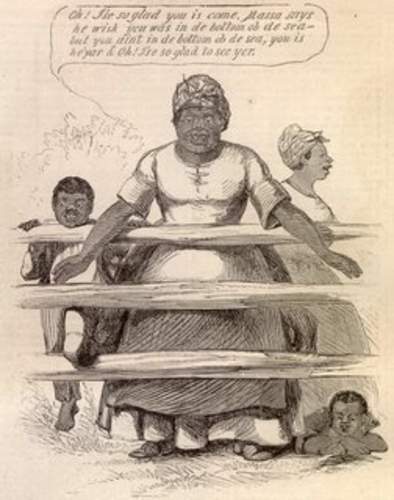
Classical representations of the concept of the Mammy are that she is very dark, in the sense that she retains primarily the African features and is also often construed to be overweight. The Mammy is usually an older Black woman past child bearing age. Patricia Hill Collins says in her book Black Feminist Thought, that the Mammy is “the faithful, obedient domestic servant” (71). Her physical attributes are understood to embody the white conception of the ideal Black person. Her mode of being in white antebellum society is maid, nurse, and mother-figure for slaveholding families. She is the caregiver to all persons on the plantation, which situates her in the middle of all affairs, as a noble affiliate ready for service in all social fronts. She is seen as neither feminine nor masculine, and is portrayed as the total embodiment of domesticity. This image or representation is assumed to carry certain qualities that play a hand in oppression of Black women.
As stated above, the Mammy is said to be faithful and obedient, her obedience is primary towards the white slave master and patriarchal society. It is assumed that her relations in white society are purely physical, by which her duties entail the manual labor of the ‘House’. She is set-up as the polar opposite to the traditional concept of “cult of true womanhood”. Her physical labor and responsibilities in the ‘House’ is so far removed from that of the white woman that there can be no commonalities to connect the two. She carries more sway in both the private and public domains than that her white counterpart and she is said to occupy a male-type domesticity. The Mammy, being older and past child bearing age, is looked upon as a nons*xual object; neither master nor mistress will have to worry about s*xual advances on and from her. She is also seen to be devoid of the faculty of reason, which implies that she cannot function without being instructed or given tasks to perform. Hence, the stereotype of the Mammy justifies white oppression of Black women. This image is used to construct the idea of the ideal Black women, one that is harmless, hardworking, thoughtless, and faithful in her service to her master.
“[T]he Jezebel, whore, or s*xually aggressive women—is central in this nexus of elite white male images of Black women-hood,” says Hill Collins (77). The concept of the Jezebel stems from the biblical account in I and II Kings of the Phoenician wife of Ahab, who lured the children of Israel to worship the pagan god Baal. Traditionally the Jezebel is seen as an imprudent, shameless, or morally unrestrained woman. As highly s*xual, the Jezebel is a threat to the social fiber of America. Her clothes are s*xually expressive, usually very revealing. She is very selfish, willing to do what ever it will take to achieve her desires, which are driven by passions of animalistic sensibilities. Her nature is at best described as a type of demon-lover, where she takes possession over the male, making him unable to control his actions and passions. Jezebel is evil in the eyes of the white man, for she is constantly awaiting an opportunity to overthrow the patriarchal system. By being s*xually charged, she is conceived to be very fertile, whereby producing many children easily. This representation has played a major role in the construction of negative ideas in regards to Black women.
This image has played significant part in the degradation of the Black woman. Today’s mass media has utilized this representation to sell countless s*xually oriented products, earning companies unconceivable profits. Black women thorough this conception is also set as a polar opposite to the idea of the “cult of true womanhood”. They are perceived to be devoid of virtue and are objectified as s*xual objects. When we see pictures portraying black women as the Jezebel, we are being unconsciously programmed to view the Black woman in the light of the Jezebel. They appear dominate, self-assertive, aggressive, and manipulative. The Jezebel wares her s*xuality on her sleeve, so to say, and will rely on it to get what she wants. Black women that fall into this category are assumed to be risky and exotic, whereby their temptations if heeded to will have the definite of harm on the benevolent male figure.
The Welfare Queen/Mother is another controlling image constructed by the white patriarchy of American society. This is a hybrid image of the Mammy and Jezebel representations combined. This image has prevailed in today’s contemporary as a vehicle of oppression for the Black woman. She is seen to possess an uncontrollable s*xuality, low morals, and an inability to be productive in society (78). She has little or no education, low self-esteem, and has mothered several children by numerous fathers. The Welfare Queen/Mother is represented as unmarried; woman of meager means, relaying of the aid of the government as a primary source of income and stability. She most likely lives in a housing project or some poverty stricken section of a town or city subsidized by the government. With these characteristics combined, the Welfare Queen/Mother lives a hopeless life.
Some assumptions made about the Black women on the basis of the Welfare Queen/Mother stereotype is that she contributes directly to the condition of the poverty stricken Blacks in the U.S., who possess low morals, little if any economic mobility, and poor education. The Welfare Queen/Mother is said to instill this character defect into her children by way of providing a negative example of womanhood and male-guidance. It is also assumed that she is of no threat to the patriarchal institution, because she accepts her position in society without question or attempt of change. She is said to seek any possible way to pimp the “system”. White society today mark black women superficially by lumping them unto a box and assuming that they “wear bright and exotic colored clothing, makeup, and hairstyles.
In all, we have surveyed three major stereotypes that plagued our generation and degrade the Black woman. These images and ideas steam form chattel sentiments perpetuated by the white slave master, to control the social, political, and economic mobility of slaves in America. These images play off of pseudo-scientific theories designed to marginalize an entire race of people while certifying another as being superior. We must first learn to recognize these images so we will not be bamboozled by such representation of the Black woman, which continues to lead to their degradation. Many social activists have stated that the future of the race depends on the condition of the Black woman, if this is true; we as a people of a common humanity are obliged to take concern and act on behalf the Black woman to eliminate such images and ideologies out of our society and out of our world.
Works Cited
Hill Collins, Patricia. Black Feminist Thought: Knowledge, Consciousness, and the Politics of Empowerment. New York: Routledge, 1991.67-78.
Merriam-Webster Online Dictionary. . (12 February 2006).
~Moshee
What a person observes in life can be and is often interpreted by someone else in a totally different manner or light. When we consider the concept of stereotype, one is forced to acknowledge the presence of subjectivity. Every idea that falls under this conception is purely relative to the observer. Merriam-Webster’s Online Dictionary defines a stereotype as “a standardized mental picture that is held in common by members of a group and that represents an oversimplified opinion, prejudiced attitude, or uncritical judgment” (Merriam-Webster). This means images and representations have implied meanings in certain contexts. Stereotypes often take the negative appeal when prescribed to a group or individual, especially in a society such as the U.S., stereotypes influence social and economic affairs. This paper will explore three basic stereotypes of Black women in the U.S.; the Mammy, the Jezebel, and the Welfare Queen/ Mother as tenets of oppression utilized by white patriarchal society.
Classical representations of the concept of the Mammy are that she is very dark, in the sense that she retains primarily the African features and is also often construed to be overweight. The Mammy is usually an older Black woman past child bearing age. Patricia Hill Collins says in her book Black Feminist Thought, that the Mammy is “the faithful, obedient domestic servant” (71). Her physical attributes are understood to embody the white conception of the ideal Black person. Her mode of being in white antebellum society is maid, nurse, and mother-figure for slaveholding families. She is the caregiver to all persons on the plantation, which situates her in the middle of all affairs, as a noble affiliate ready for service in all social fronts. She is seen as neither feminine nor masculine, and is portrayed as the total embodiment of domesticity. This image or representation is assumed to carry certain qualities that play a hand in oppression of Black women.
As stated above, the Mammy is said to be faithful and obedient, her obedience is primary towards the white slave master and patriarchal society. It is assumed that her relations in white society are purely physical, by which her duties entail the manual labor of the ‘House’. She is set-up as the polar opposite to the traditional concept of “cult of true womanhood”. Her physical labor and responsibilities in the ‘House’ is so far removed from that of the white woman that there can be no commonalities to connect the two. She carries more sway in both the private and public domains than that her white counterpart and she is said to occupy a male-type domesticity. The Mammy, being older and past child bearing age, is looked upon as a nons*xual object; neither master nor mistress will have to worry about s*xual advances on and from her. She is also seen to be devoid of the faculty of reason, which implies that she cannot function without being instructed or given tasks to perform. Hence, the stereotype of the Mammy justifies white oppression of Black women. This image is used to construct the idea of the ideal Black women, one that is harmless, hardworking, thoughtless, and faithful in her service to her master.
“[T]he Jezebel, whore, or s*xually aggressive women—is central in this nexus of elite white male images of Black women-hood,” says Hill Collins (77). The concept of the Jezebel stems from the biblical account in I and II Kings of the Phoenician wife of Ahab, who lured the children of Israel to worship the pagan god Baal. Traditionally the Jezebel is seen as an imprudent, shameless, or morally unrestrained woman. As highly s*xual, the Jezebel is a threat to the social fiber of America. Her clothes are s*xually expressive, usually very revealing. She is very selfish, willing to do what ever it will take to achieve her desires, which are driven by passions of animalistic sensibilities. Her nature is at best described as a type of demon-lover, where she takes possession over the male, making him unable to control his actions and passions. Jezebel is evil in the eyes of the white man, for she is constantly awaiting an opportunity to overthrow the patriarchal system. By being s*xually charged, she is conceived to be very fertile, whereby producing many children easily. This representation has played a major role in the construction of negative ideas in regards to Black women.
This image has played significant part in the degradation of the Black woman. Today’s mass media has utilized this representation to sell countless s*xually oriented products, earning companies unconceivable profits. Black women thorough this conception is also set as a polar opposite to the idea of the “cult of true womanhood”. They are perceived to be devoid of virtue and are objectified as s*xual objects. When we see pictures portraying black women as the Jezebel, we are being unconsciously programmed to view the Black woman in the light of the Jezebel. They appear dominate, self-assertive, aggressive, and manipulative. The Jezebel wares her s*xuality on her sleeve, so to say, and will rely on it to get what she wants. Black women that fall into this category are assumed to be risky and exotic, whereby their temptations if heeded to will have the definite of harm on the benevolent male figure.
The Welfare Queen/Mother is another controlling image constructed by the white patriarchy of American society. This is a hybrid image of the Mammy and Jezebel representations combined. This image has prevailed in today’s contemporary as a vehicle of oppression for the Black woman. She is seen to possess an uncontrollable s*xuality, low morals, and an inability to be productive in society (78). She has little or no education, low self-esteem, and has mothered several children by numerous fathers. The Welfare Queen/Mother is represented as unmarried; woman of meager means, relaying of the aid of the government as a primary source of income and stability. She most likely lives in a housing project or some poverty stricken section of a town or city subsidized by the government. With these characteristics combined, the Welfare Queen/Mother lives a hopeless life.
Some assumptions made about the Black women on the basis of the Welfare Queen/Mother stereotype is that she contributes directly to the condition of the poverty stricken Blacks in the U.S., who possess low morals, little if any economic mobility, and poor education. The Welfare Queen/Mother is said to instill this character defect into her children by way of providing a negative example of womanhood and male-guidance. It is also assumed that she is of no threat to the patriarchal institution, because she accepts her position in society without question or attempt of change. She is said to seek any possible way to pimp the “system”. White society today mark black women superficially by lumping them unto a box and assuming that they “wear bright and exotic colored clothing, makeup, and hairstyles.
In all, we have surveyed three major stereotypes that plagued our generation and degrade the Black woman. These images and ideas steam form chattel sentiments perpetuated by the white slave master, to control the social, political, and economic mobility of slaves in America. These images play off of pseudo-scientific theories designed to marginalize an entire race of people while certifying another as being superior. We must first learn to recognize these images so we will not be bamboozled by such representation of the Black woman, which continues to lead to their degradation. Many social activists have stated that the future of the race depends on the condition of the Black woman, if this is true; we as a people of a common humanity are obliged to take concern and act on behalf the Black woman to eliminate such images and ideologies out of our society and out of our world.
Works Cited
Hill Collins, Patricia. Black Feminist Thought: Knowledge, Consciousness, and the Politics of Empowerment. New York: Routledge, 1991.67-78.
Merriam-Webster Online Dictionary. . (12 February 2006).
~Moshee


