
Dr. John Hope Franklin Says We Got Step Our Game Up

The Prominent Historian Speaks Out On The Real Work Of Ending Discrimination
By Olufunke Moses
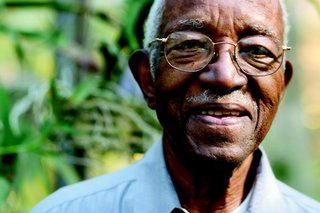
Dr. John Hope Franklin is wearing shades of brown: a brown camel-colored blazer, dark brown vest, caramel and chocolate silk tie and brown slacks. His 6-feet-plus frame is brown (and slightly stooped with age); his dark brown complexion expressive still, even more so with the wrinkles and wisdom of his years.
So he has: a doctorate from Harvard, professorships at St. Augustine's College and N.C. Central among others, chairman of the history departments at Brooklyn College and the University of Chicago, professor of legal history at Duke and now the James B. Duke Professor of History Emeritus at Duke. He's the author of numerous books, including the seminal From Slavery to Freedom: A History of African-Americans, now in its seventh edition, and winner of the Presidential Medal of Freedom and the 2006 John W. Kluge award for his lifetime achievements in the humanities. (Franklin split the $1 million prize with historian Yu Ying-Shih.) He has accomplished much. But still, he is not satisfied with the America he sees for future generations.
And he talks about this dissatisfaction as often as he has an opportunity, no matter the many who find the continued conversation on matters of race or slavery or reparations or apologies tiring. "Americans are getting tired of anything that's constructive or serious, so I'm not disturbed that they find this [discussion] a bore or problem," he says.
On the Martin Luther King Jr. holiday, in January, Virginia legislator Frank Hargrove was clearly among the bored, judging by his response to a resolution that the state of Virginia apologize for slavery. Hargrove suggested that it was counterproductive to dwell on slavery, and that Virginia's black citizens should just "get over it." The Virginia Assembly promptly followed the ensuing controversy by becoming the first American state to pass a measure—fully supported by Hargrove—expressing "profound regret" for the state's role in slavery.
Now North Carolina has gotten into the act. The state House and Senate just passed a resolution that expresses "the profound regret of the North Carolina General Assembly for the history of wrongs inflicted upon black citizens by means of slavery, exploitation, and legalized legal segregation and calling on all citizens to take part in acts of racial reconciliation."
But one has to wonder how far apologies will go in righting past wrongs. Is it the scab that, left unbothered, will heal wounds, or is it merely a quick-fix Band-Aid, slapped on to make the ugliness of injury just go away?
Franklin, who knows what it is to grow up in a world where one's rights and equalities are constantly being questioned, refuses to let go. He thinks it's not just time for somebody to apologize, but to do something about it.
"No one knows the price that I've paid for what I've gotten out of this world and this life," he says. "My efforts represented sacrifices untold, indescribable. They don't know what my mother went through to see that I had opportunities, and even the fundamentals such as food and clothing and so forth. They don't know what my grandfather, on my father's side, paid in terms of taxes so that white young men could go to the University of Oklahoma, where my own father could not go.
"And I don't see any reason why I should get over that kind of exploitation of my immediate family—my father, my grandfather, my mother, and so forth. I see no reason I should get over it. I see every reason why there should be compensation, apologies, particularly in the hypocrisy it's represented, in their saying on the one hand that all men are created equal, and on the other hand, them saying if they're created equal, some are more equal than others."
We talked to Franklin in January and then last week about apologies and the politics of slavery and the post-Reconstruction era that created the need for one.
Independent: What do you think of the General Assembly's apology last week for slavery?
Dr. John Hope Franklin: It's going to become epidemic now. People are running around apologizing for slavery. What about that awful period since slavery—Reconstruction, Jim Crow and all the rest? And what about the enormous wealth that was built up by black labor? If I was sitting on a billion dollars that someone had made when I sat on them, I probably would not be slow to apologize, if that's all it takes. I think that's little to pay for the gazillions that black people built up—the wealth of this country—with their labor, and now you're going to say I'm sorry I beat the hell out of you for all these years? That's not enough. They ought to develop some kind of modus operandi that they can do something else—something to absolve themselves of three centuries of guilt from which they are the direct beneficiaries.
How large is the black population now living in abject poverty in this country? How large is the population of blacks who have poor health? Sometimes they inherited the poor health right from their forebears who were beaten and treated like they were animals all over this country. It's simply not enough. And I'm impatient with the piety that goes along with it. They're so syrupy in their apologies. What does it cost? Nothing.
What else do you think they should do?
Why don't they work on that instead of trying to draft a syrupy apology. I don't have to work on it. They have to work on this. They're the ones with the guilt from the treatment of my people. Then I'll decide if it's enough.
This past November, The News & Observer and other North Carolina newspapers revisited the Wilmington race riots in a 16-page supplement subtitled "Wilmington's Race Riot and the Rise of White Supremacy," a response to a 300-page report published by the 1898 Wilmington Race Riot Commission. (Visit [url=http://www.ah.dcr.state.nc.us/1898-wrrc]1898 Wilmington Race Riot Commission[/url] for the full commission report or [url=http://www.newsobserver.com/1370/story/511596.html]newsobserver.com | The Ghosts of 1898[/url] for the N&O Wilmington Race Riot supplement.) What are your thoughts on these recommendations, and are there any you would add?
I think the recommendations are commendable. I don't know if they go far enough; they go pretty far to the extent that they undertake to reverse the sentiments and to establish a new basis for racial harmony, not only in New Hanover County but also throughout the state. I can only hope that they do almost as much as they propose to do.
It's a big order and I must say, if the recommendations are seriously considered by the population of this state, we will be doing a remarkable job in moving in the right direction.
We've had difficulty in securing or getting groups to acknowledge their mistakes and to pledge to do better—that's been a very difficult task, especially in the area of race relations. If they want the [N.C.] Department of Public Instruction, for example, to revise the curriculum and take steps to teach the younger children about what happened in Wilmington in 1898, that's most commendable.
We'll have to wait and see before I can believe it—if it can be done or if it will be done.
When I was chairman of [Bill Clinton's] president's advisory board on race, I found very few groups that wanted to acknowledge that they had made mistakes in the past, and that it would be well to reconsider them and apologize for them—very seldom did I find any group that was willing to do that.
I'm not at all certain that we can find any groups that want to give up any property or any resources that they've gained through the years as a result of the way in which they acquired these properties and so forth. They simply don't want to think about it or to do anything about it. And if they do, in this case, I would be delighted, but surprised.
There have been suggestions recently that the statue of Josephus Daniels in Raleigh's Nash Square should be removed because of his role in the massacre as a Democratic Party leader and owner and editor of The N&O. How do you feel about that?
Josephus reviewed my first book in 1943 (The Free Negro in North Carolina). Oh, he was very cordial. It wasn't difficult for him to review it favorably, and he did review it favorably. He's on the right side of everything by 1943.
I don't have any problem with his statue. It ought to be pointed out what kind of man he was. He did a lot of things that are good and he might deserve it, but it ought to be pointed out that he led the coup to overthrow the government in Wilmington, and that he ran a racist newspaper for years. In Raleigh, I don't have any problem with the monument. We can't go around tearing down all the [Thomas] Jefferson monuments, and he was a prime racist.
[Read More on the article]


