
Your Child's Name Could Be Causing The Problem..
Commentary: Exotic Names Might Sound Special, but They May Hinder the Children Who Have Them
Date: Tuesday, May 17, 2005
By: Tonyaa Weathersbee, BlackAmericaWeb.com
Sadly enough, too many of our black children spend their school years struggling with burdens imposed by impoverished communities and low self-esteem.
But now, recent research tells us that something else borne of that background may be adding to their struggles.
That something else is their names.
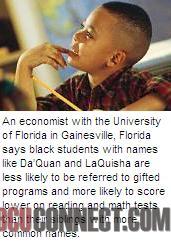
According to research by David Figlio, an economist with the University of Florida in Gainesville, Fla., black students with names like Da’Quan and LaQuisha are less likely to be referred to gifted programs and more likely to score lower on reading and math tests than their siblings with more common names. He came to his conclusions after analyzing information on 55,046 children from 24,298 families with two or more children enrolled in a large Florida school district from 1994 to 2001.
What Figlio found was that even within the same families, teachers treated students differently if their names connoted low socio-economic status. He also found that the most frequent name attributes given by poorly-educated black women were names that began with prefixes such as “Lo,” “Ta,” and “Qua,” and ended with suffixes like “isha,” and “ious.” Many of those names also began with apostrophes and were excruciatingly long.
Figlio, whose findings were publicized in a UF news release, said his study suggests that black children may suffer more academically because many of them have names that suggest they are poor – and many teachers may automatically lower the bar of expectations for them.
In the release, Figlio states: “When you see a particular name, like David or Catherine, you internalize it in a different way than a name such as LaQuisha. And it could be that teachers start to make inferences about a student’s parents, the parent’s education level and the parents’ commitment to their children’s education based on the names the parents give their children.”
In other words, teachers don’t expect LaQuisha’s mother to show up at PTA meetings. Nor do they expect much out of LaQuisha either.
That’s too bad. But biases against black-sounding names aren’t new.
Two years ago, one study done by researchers from the National Bureau of Economic Research found that employers were half as likely to respond to resumes with black-sounding names than they were to comparable resumes with white-sounding names on comparable resumes.
So what to do?
Well, we could give our children simpler, more pronounceable names. Names like LaQuanisha and De’Aundreus have never done anything for me. I’ve always believed that in many cases, such names are the result of attempts by poor women to exercise their creativity on their babies – the only canvases they’ve been brainwashed to believe are available to them. On top of that, the proliferation of such long, unpronounceable names is more common than unique now – so if the mother is trying to be different, well, she won’t be.
But at the same time, giving our children names like Brandon and Heather isn’t the solution either. To give our children white-sounding names just for the sake of fitting in would be selling out to a society that has, since slavery times, sought to make us give up our identities for their convenience. Doing that would defile the legacy of enslaved Africans such as Kunta Kinte – the Mandinka ancestor of “Roots” author Alex Haley – who almost allowed himself to be beaten to death before answering to his slave name Toby.
Yet when Kunta Kinte named his daughter Kizzy, it had an ancestral meaning. It meant “stay put,” in reflection of his desire for his family to stay together.
I doubt if names like Ta’Naquisha carry any such symbolism.
But for black parents who insist on exotic names, there is an answer to dealing with the problems that such a name might present.
The answer is to simply be parents.
If we are going to be courageous enough to name our children what we want, we have to become courageous enough to be so involved in our children’s education so that teachers who might overlook them or attempt to treat them differently don’t have a chance to do so. We have to have the guts to ask why our children aren’t being tested for gifted programs and the like.
And we have to understand that the hard work of being a parent doesn’t end with the concoction of a hard-to-pronounce name.
Figlio’s study was revealing. But what it also shows is that it’s still up to us to see to it that our children’s names become symbols of accomplishment.
And not another cross to bear.
Date: Tuesday, May 17, 2005
By: Tonyaa Weathersbee, BlackAmericaWeb.com
Sadly enough, too many of our black children spend their school years struggling with burdens imposed by impoverished communities and low self-esteem.
But now, recent research tells us that something else borne of that background may be adding to their struggles.
That something else is their names.
According to research by David Figlio, an economist with the University of Florida in Gainesville, Fla., black students with names like Da’Quan and LaQuisha are less likely to be referred to gifted programs and more likely to score lower on reading and math tests than their siblings with more common names. He came to his conclusions after analyzing information on 55,046 children from 24,298 families with two or more children enrolled in a large Florida school district from 1994 to 2001.
What Figlio found was that even within the same families, teachers treated students differently if their names connoted low socio-economic status. He also found that the most frequent name attributes given by poorly-educated black women were names that began with prefixes such as “Lo,” “Ta,” and “Qua,” and ended with suffixes like “isha,” and “ious.” Many of those names also began with apostrophes and were excruciatingly long.
Figlio, whose findings were publicized in a UF news release, said his study suggests that black children may suffer more academically because many of them have names that suggest they are poor – and many teachers may automatically lower the bar of expectations for them.
In the release, Figlio states: “When you see a particular name, like David or Catherine, you internalize it in a different way than a name such as LaQuisha. And it could be that teachers start to make inferences about a student’s parents, the parent’s education level and the parents’ commitment to their children’s education based on the names the parents give their children.”
In other words, teachers don’t expect LaQuisha’s mother to show up at PTA meetings. Nor do they expect much out of LaQuisha either.
That’s too bad. But biases against black-sounding names aren’t new.
Two years ago, one study done by researchers from the National Bureau of Economic Research found that employers were half as likely to respond to resumes with black-sounding names than they were to comparable resumes with white-sounding names on comparable resumes.
So what to do?
Well, we could give our children simpler, more pronounceable names. Names like LaQuanisha and De’Aundreus have never done anything for me. I’ve always believed that in many cases, such names are the result of attempts by poor women to exercise their creativity on their babies – the only canvases they’ve been brainwashed to believe are available to them. On top of that, the proliferation of such long, unpronounceable names is more common than unique now – so if the mother is trying to be different, well, she won’t be.
But at the same time, giving our children names like Brandon and Heather isn’t the solution either. To give our children white-sounding names just for the sake of fitting in would be selling out to a society that has, since slavery times, sought to make us give up our identities for their convenience. Doing that would defile the legacy of enslaved Africans such as Kunta Kinte – the Mandinka ancestor of “Roots” author Alex Haley – who almost allowed himself to be beaten to death before answering to his slave name Toby.
Yet when Kunta Kinte named his daughter Kizzy, it had an ancestral meaning. It meant “stay put,” in reflection of his desire for his family to stay together.
I doubt if names like Ta’Naquisha carry any such symbolism.
But for black parents who insist on exotic names, there is an answer to dealing with the problems that such a name might present.
The answer is to simply be parents.
If we are going to be courageous enough to name our children what we want, we have to become courageous enough to be so involved in our children’s education so that teachers who might overlook them or attempt to treat them differently don’t have a chance to do so. We have to have the guts to ask why our children aren’t being tested for gifted programs and the like.
And we have to understand that the hard work of being a parent doesn’t end with the concoction of a hard-to-pronounce name.
Figlio’s study was revealing. But what it also shows is that it’s still up to us to see to it that our children’s names become symbols of accomplishment.
And not another cross to bear.