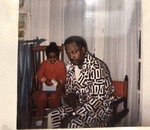
Inside the Life of the Producer Who Defined the Makaveli Sound
In the crowded mythology of hip-hop’s golden era—where legends are spoken of in shorthand and entire histories reduced to a few familiar names—one truth has gone frustratingly under-acknowledged: Darryl Harper, also known as Big D, was not merely present during one of rap’s most volatile, creative, and historic moments.
He was instrumental.
A veteran producer with a sound unmistakably rooted in grit, soul, and musical intuition, Harper became one of the hidden architects of 1990s West Coast hip-hop. His contributions shaped an entire cultural era, and yet his genius—like so many producers behind the boards—has never been fully illuminated.
This is the story of the most underrated producer of all time.
A Quiet Beginning for a Quiet Giant
Born Darryl Marvin Harper, he came of age in an environment where rhythm was not merely entertainment—it was identity, survival, and communication. Publicly available details about Harper’s early years are minimal, but what isknown is that he emerged with a musician’s ear and a technician’s discipline. The future “Big D” was the kind of kid who dissected songs instead of simply listening to them. He studied chord movement, drum textures, and vocal cadence long before he ever set foot in a major studio.
His entry into professional music came the way it often does for the true craftsmen: quietly, steadily, through relentless work ethic and an insistence on excellence. Long before he was shoulder-to-shoulder with Death Row’s top talent, Harper was already training himself to be undeniable.
And the Making of a Super-Producer
By the mid-1990s, Death Row Records was the most explosive label in hip-hop—a cultural supernova producing stars, controversy, and timeless records. This was the battleground where Harper would carve his legacy.
When Tupac Shakur entered Death Row in 1995, the label’s creative engine kicked into an even higher gear. And within that whirlwind, there was one producer whose instincts aligned perfectly with Pac’s creative urgency: Darryl Harper.
What happened next became the stuff of rap lore.
In 1996, Tupac shifted personas, adopting the alias Makaveli, signaling a darker, sharper era of artistry. The resulting album—The Don Killuminati: The 7 Day Theory—was crafted in an almost impossibly short timeframe, with Harper as a primary producer and sonic gatekeeper.
Harper produced some of the most haunting, emotionally charged, and spiritually intense music ever recorded in hip-hop:
“Hail Mary” – the apocalyptic masterpiece still considered one of hip-hop’s greatest songs
“Me and My Girlfriend” – a brilliant metaphorical narrative later reimagined by JAY-Z and Beyoncé
“Krazy” – a spiritual, introspective anthem that remains a fan favorite
“The Good Die Young”, “Military Minds”, and other unreleased/alternate era tracks cherished by collectors and deep-cut fans
He didn’t just produce beats—he shaped the mood of the Makaveli era.
Dark. Urgent. Prophetic.
It was Harper’s production—moody, cinematic, and emotionally charged—that gave 2Pac the landscape to deliver some of his most powerful work.
To see the full article, logon at:
https://open.substack.com/pub/robprguy/p/t...

 Posted By: Robert Walker
Wednesday, February 25th 2026 at 7:13PM
You can also
click
here to view all posts by this author...